
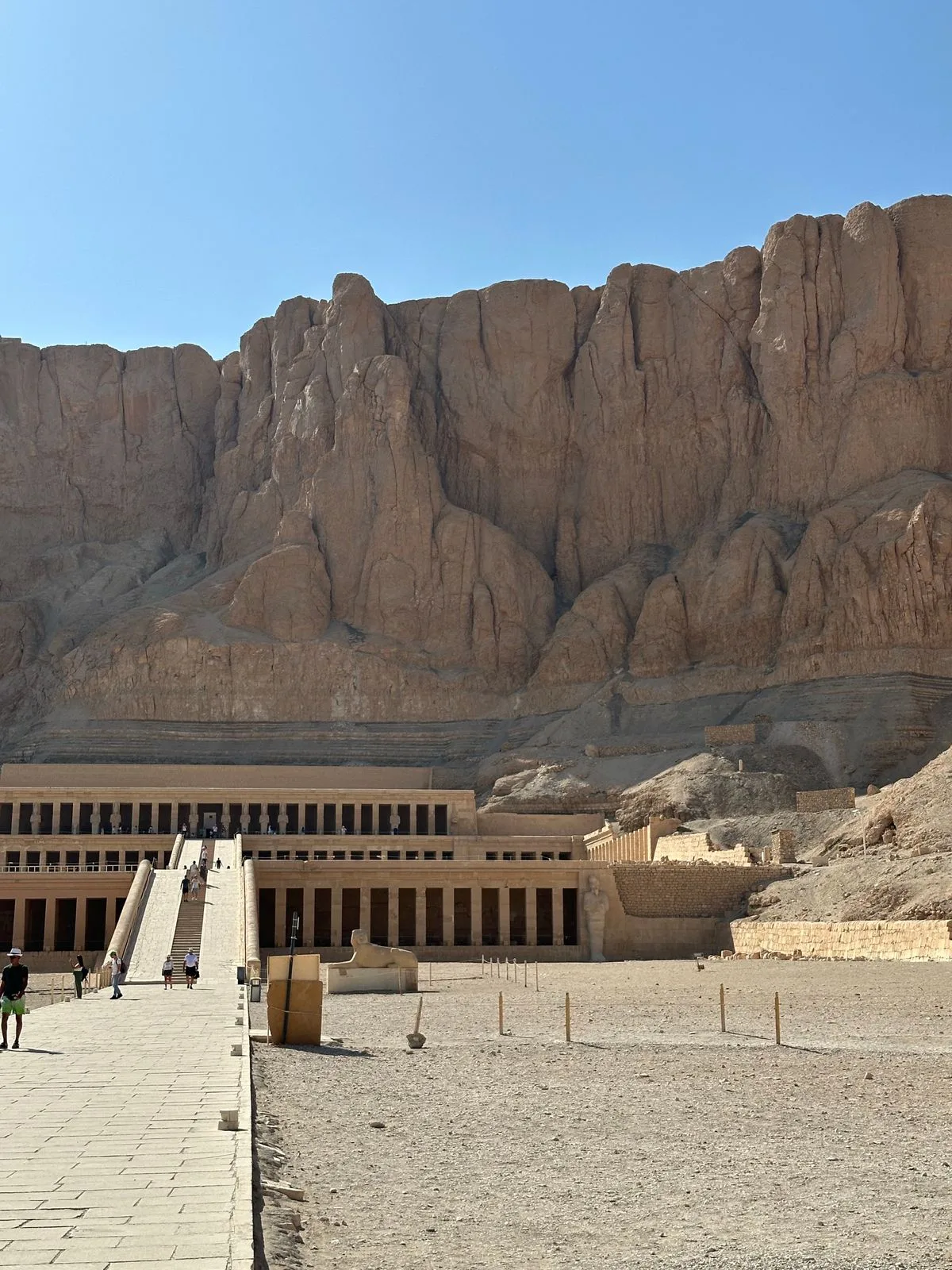
The Hatshepsut Temple — Djeser-Djeseru, “the Holy of Holies” — rises in three vast terraces against the cliffs of Deir el-Bahari on Luxor’s West Bank. Built for Egypt’s most successful female pharaoh, it is the most architecturally striking monument in Luxor. Here is what to know before you stand under those colonnades.
Quick Answer: The Mortuary Temple of Hatshepsut at Deir el-Bahari is a three-terraced temple built into the cliffs of Luxor’s West Bank around 1470 BC, dedicated to the female pharaoh Hatshepsut and the god Amun. It sits minutes from the Valley of the Kings and is usually visited together with it.
- Known in ancient Egyptian as Djeser-Djeseru — “Holy of Holies”.
- Famous for its terraces, the Punt expedition reliefs and the Hathor chapel.
- Visit early: the amphitheater of cliffs turns into an oven by late morning.
Who Was Hatshepsut?
Hatshepsut ruled Egypt for about two decades in the 15th century BC — first as regent for her stepson Thutmose III, then as pharaoh in her own right, portrayed with the royal beard and full titles. Her reign was one of peace, trade and building; her expedition to the land of Punt (probably the Horn of Africa) is carved along her temple’s walls: incense trees in pots, exotic animals, the famously stout Queen of Punt.
The Temple, Terrace by Terrace
The Lower and Middle Terraces
Long ramps climb between colonnades. The middle terrace holds the Punt reliefs on one side and the birth colonnade on the other — the carved story legitimizing Hatshepsut as the god Amun’s own daughter. The Hathor chapel at its end keeps its cow-eared columns.
The Upper Terrace
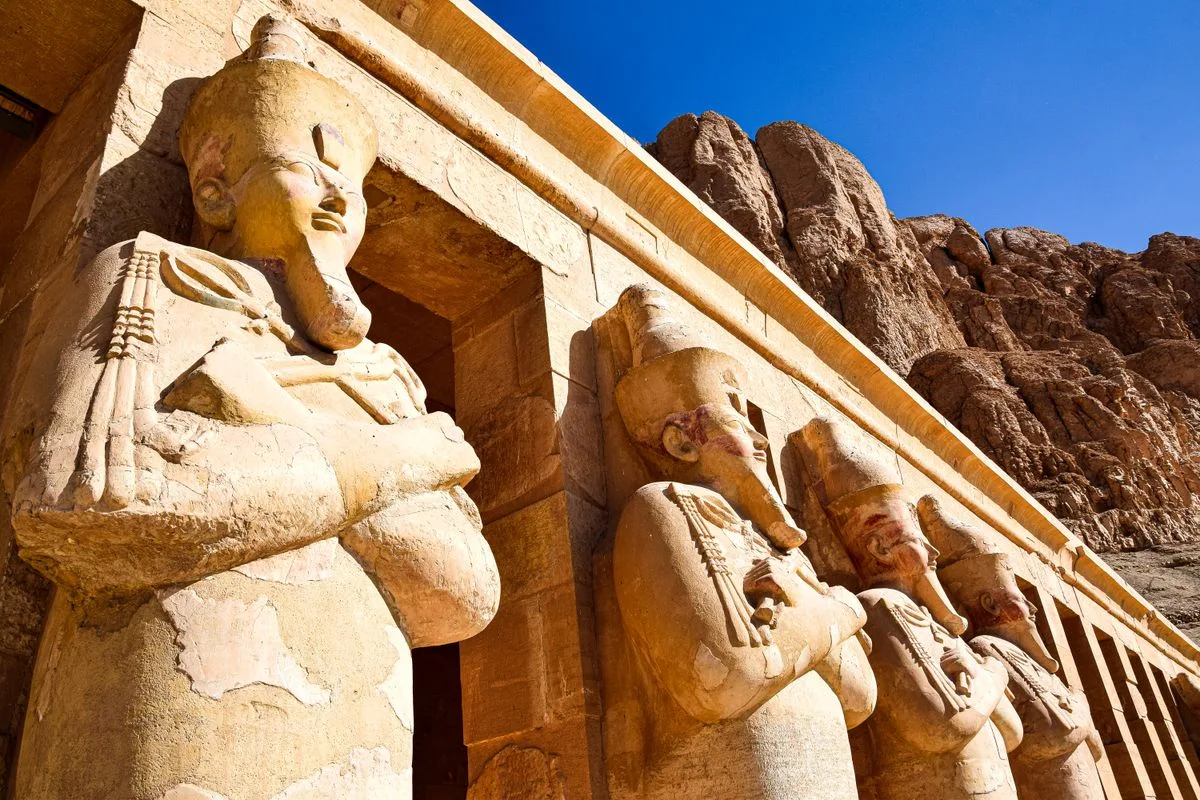
A row of Osiride statues of Hatshepsut as pharaoh faces the river. Behind lies the sanctuary cut into the living rock, aligned so that on the winter solstice the sun reaches the inner chapel.
After Her Death
Thutmose III — or his successors — had Hatshepsut’s images chiseled out across Egypt decades after she died, which is why many statues here are reconstructed from fragments. The story of her erasure and rediscovery is one of Egyptology’s great detective tales; your guide can point out where the hammers fell.
Visiting Information
| Detail | What to know |
|---|---|
| Location | Deir el-Bahari, West Bank, Luxor — beside the Valley of the Kings ridge |
| Time needed | About 1 hour |
| Best hour | Early morning — the cliff bowl amplifies heat fast |
| Combine with | Valley of the Kings + Medinet Habu or Deir el-Medina |
How It Fits a West Bank Day
Hatshepsut’s temple is the classic second stop after the Valley of the Kings, with the Colossi of Memnon on the drive. That trio is the core of our private Valley of the Kings tour. Add Medinet Habu if you want the West Bank’s best-kept secret in the same morning.
Djeser-Djeseru, the mortuary Hatshepsut Temple, sits within Ancient Thebes, listed as a UNESCO World Heritage Site. Read the official entry at the UNESCO World Heritage Centre.
FAQs About Hatshepsut Temple
What is Djeser-Djeseru?
The ancient name of Hatshepsut’s mortuary temple at Deir el-Bahari — it means “Holy of Holies”. The modern terraced restoration is largely faithful to its original form.
Why is Hatshepsut’s temple so different from other Egyptian temples?
Its architect Senenmut built with the cliff instead of against it — horizontal terraces mirroring the rock strata. There is nothing else like it in Egypt.
How long do you need at the temple?
About an hour on site. It is compact compared with Karnak — the impact is the setting.
Was Hatshepsut buried here?
No — the temple was for her cult. Her intended tomb, KV20, lies over the ridge in the Valley of the Kings.
Is Hatshepsut temple included in Valley of the Kings tours?
In most full West Bank tours, yes — including ours. Check the itinerary of any Luxor tour before booking.
Standing under those terraces at 7am is the way to do it. Message us on WhatsApp or see the full Luxor travel guide to plan the day around it.
